

Book Review: Nachiket Sutra by Harish Meenashru
 Aanchal Singh
Author
Aanchal Singh
Author
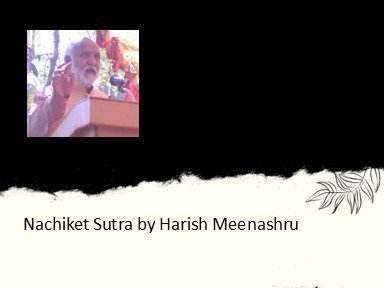
Harish Meenashru is a renowned voice in Gujarati Literature. Meenashru is a pen name of Gujarati author Harish Dave who belongs to Anand (Gujarat) His contribution to Gujarati literature is invaluable. The poet has the degree of M.Sc. in Chemistry and is a baker by profession. His passion for writing makes him a writer as well as a poet. There are 12 books to his credit. His poems are translated into Hindi, Marathi, Malayalam, Bangla, English, and German languages. Being a Gujarati poet, it is quite difficult for him to reach global readers. He is fortunate to have a friend Dr. Rajendrasinh Jadeja who has translated his Nachiket Sutra, a long narrative poem in Gujarati into English. Dr.Jadeda is a retired associate professor of English from the H.M.Patel Institute of English Training and Research Centre. Currently, he is rendering his services as the director at H.M.Patel Career Development Centre, Vallabh Vidyanagar.
The book is published by Gujarat Sahitya Academi, Gandhinagar with a note from Bhagyesh Jha, Chairperson of Gujarat Sahitya Academi, which is a credit to the poet and translator. The book begins with the publisher’s note in which he appreciates the poet and the translator. The verse of Shankaracharya denotes the lives of the saints
There are saints, calm and great,
Who brings good to others, quietly and unasked,
as does the Spring.
They have already crossed
The dreadful ocean of life themselves
And help others to cross it,
Spontaneously and without any motive.
Dr.Rajendrasinh Jadeja, the translator himself accepts the difficulties of translation in the first part of the book. It is quite difficult for the translator to translate Harish Meenashrus’s long narrative poem into English because of Gujarati Colloquial words. The writing style of the poet is also challenging for the translator. He thinks that Harish deploys the phonetic properties of the Gujarati language with rare command, creating a duet of sound and meaning in his lucid lyrical lines.
The book is based on the legend of Nachiketa who goes in search of the God of Death i.e. Yama. The poet’s quest for salvation is eye-catching in the book. The cover page of the book reveals two aspects of man’s life i.e. spiritual and materialistic. It shows that man has to leave the materialistic things to attain salvation. The poet says that nothing is permanent in life and everyone has to leave the materialistic things on this earth yet man tries to have more and more materialistic things.
No one is static
No one is kinetic either
No one goes anywhere
No one reaches anywhere
It is impossible to overcome this stasis
And reaching
Remains beyond the reach of all.
In this regard, it is worth quoting Omar Khayyam’s verse from The Rubaiyat.
Dust into Dust, and
Under Dust lie, sans
Wine, sans song, sans
Singer, and sans End!
Man is made of clay and he will be mingled into the clay at the end of life. Everyone has to accept the reality of life i.e. Death. Shakespeare asserts the same thing in his play Hamlet. As he says:
Thou knowest ‘tis common; all that lives must die,
Passing through nature to eternity
That makes the calamity of so long life.
(Hamlet, Act-I, Scene –II)
The poem is written in a pessimistic tone. The poet himself is in search of the lord of death. As he says;
I keep searching:
Where is my beloved?
Where is the Lord of Death?
Who is here all the time?
And yet an uninvited visitor eternally
For whose arrival
One remains forever in doubt
And yet is supremely certain
Everyone dies sooner or later and the body turns into ashes that making the calamity of so long life but there is a problem with self-actualization in life. Man clings to materialistic things and indulges himself in the rat race situation. The poet prays to God to solve the riddle of self-actualization.
Oh Lord, the rider of the Mahisha
Please appear right now
And decode
This riddle of self-actualization.
We find the use of Gujarati words like Roop, Ras, Gandh, Shabd, Sparsh, and Rang in the translated poem that makes it unique. The beauty of the translated poem lies in the narrative style. The poet also talks about mythological characters like Ram, Prahlad, Karn, Kunta, etc., and their fate. No one can alter the fate and everyone will turn into ashes. It seems that the poet has accepted the reality of life and believes that one day he will be a wax statue in Madam Toussad’s museum.
Since my fate ordained melting
I, the babbling bard, became
Just a wax statue in Madam Toussad’s
Life is a mixture of contradictory things, but the poet wants to establish himself in life.
Love and hate
Quarrel and qualm
Duo and duality
Annihilation and affection
What emerges from them
I do not worship that sovereign fire
I merely burn
And establish- I am.
The poet creates the alliterative effect in the poem in the following lines:
Trahimam, Trahimam- save me, oh my Lord, save me
Forgive us, Oh Mahisharaya
I offer oblation:
Om, Hom, Hring, Kling, Keep melting
The poet thinks that only Nachiket remains forever. The book ends with the worship of great mythological characters.
Oh Prashnarat, spiritual questioner, I worship you
Oh Agnivrat, one vowed to fire, I worship you
Oh Swarat, self-absorbed, I worship you
Oh Aniket, abodeless, I worship you
Oh Bhasm- shwet ashen –white, I worship you
Oh, Nachiket, I worship you.
The book is very well translated from Gujarati into English by Dr. Rajendrasinh Jadeja. The translator has very well presented the feelings of the poet in English. The book is a record of the poet’s lifelong experiences. The poet feels that he is melting after a long struggle in life. The poet talks about the irony of fate in man’s life. No one can solve the riddle of life and death. A detailed explanation of the book is also provided by Manilal H. Patel, a renowned Gujarati author. Footnotes are provided at the end of the book.








Comments (0)