Who Wrote the Book? Publishing Industry Turns to Human-Written Certification Amid AI Concerns
 Mariyam Yasser
Author
Mariyam Yasser
Author
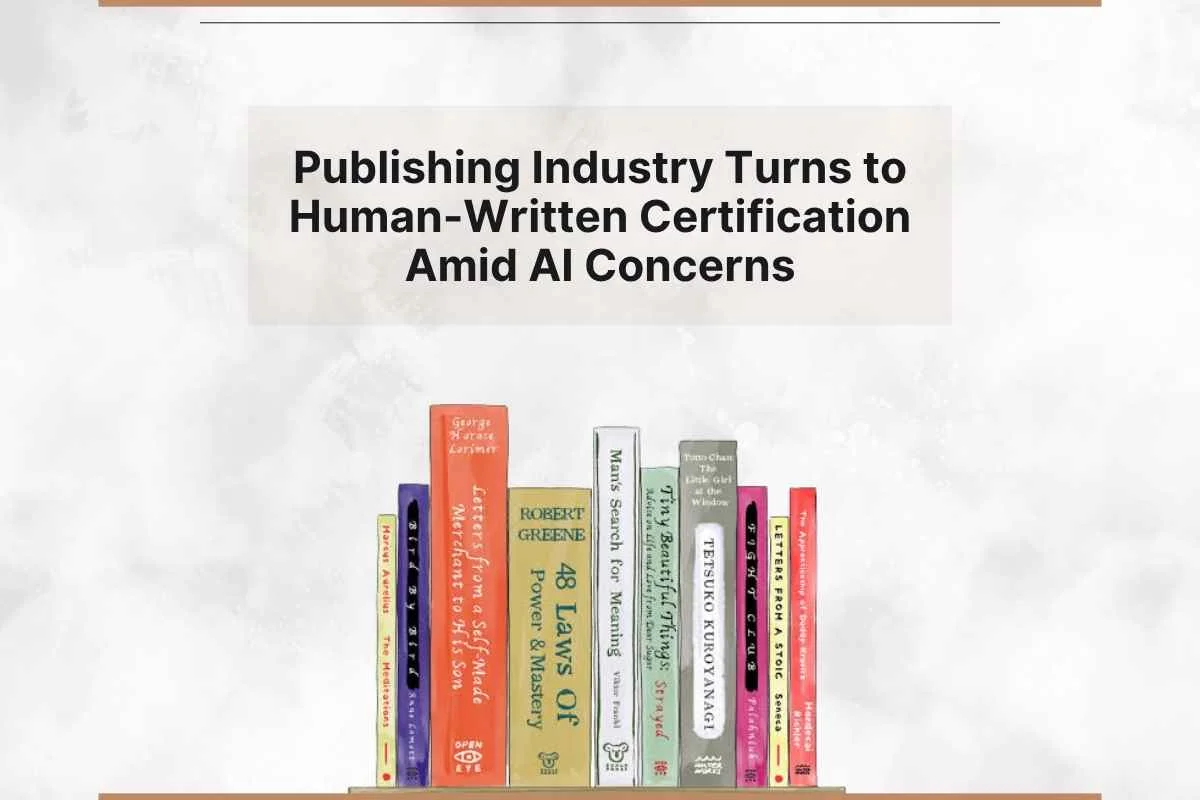
As artificial intelligence finds its way into the world of books, authors and publishers are searching for reliable ways to establish the human origin of literary works. A growing number of certification initiatives in France, Britain and Germany are attempting to address concerns about undisclosed AI use, offering labels to identify books created primarily by human writers.
The debate gained considerable attention at the Frankfurt Book Fair, where publishing professionals examined how the rapid development of AI is changing writing, publishing and readers' expectations.
Recent controversies involving authors suspected of using AI without disclosure have added urgency to the discussion. Beyond questions of originality, the incidents have raised concerns about professional credibility and the confidence readers place in published works.
Certification Efforts Gain Momentum
A major controversy in the French-language literary community recently centred on Haitian-Canadian writer Thelyson Orelien. His debut novel, It Was Either That or Die, came under scrutiny last month after an anonymous account on X alleged that AI had been used to produce the text. The allegations were based on assessments of excerpts through online AI-detection tools.
Orelien has rejected the accusations and argued that the criticism was motivated by racial prejudice. Nevertheless, the controversy led to his exclusion from consideration for France's leading literary prize.
The episode has had a significant impact on the French publishing community. Charlotte Allibert, who co-founded a company specialising in self-publishing and literary representation, described the situation as a major shock for the industry.
Her organisation provides a paid verification service for authors seeking recognition as human creators. The process combines AI-detection software with an interview conducted by an auditor, who also examines the manuscript directly. Approximately 200 books have received its “human creation” certification to date.
Allibert noted that independent writers are particularly concerned about being accused of relying on AI, even when their work is original.
British Initiative Defines Standards for Human Writing
Britain has also taken a step towards formalising the distinction between human-written books and those produced using AI. A startup recently announced that its certification mark for human-authored literature had been registered with the country's intellectual property office.
Its framework, described as “organic literature”, requires the writing to originate with the author while permitting restricted AI assistance for routine tasks, including spelling and grammar corrections.
Co-founder Esme Dennys explained that the initiative seeks to provide authors and publishers with a dependable and transparent set of standards. She also reported a noticeable rise in enquiries from different parts of the world as concerns about undisclosed AI involvement continue to grow.
The programme initially brought together five independent publishers, with further additions expected in the coming months. Participating publishers can request certification for books written by their authors.
In the United States, the Authors Guild has established a comparable system. Its “human authored” mark operates through self-certification, requiring writers to sign a licensing agreement. Around 6,500 titles have received the designation so far.
Publishing Disputes Raise Questions About AI Use
The growing demand for verification has followed several high-profile disputes over the use of AI in literary production.
Earlier this year, Hachette halted the publication of Mia Ballard's horror novel Shy Girl in the United States and removed it from the British market after allegations emerged that AI had been involved in its creation.
Speaking to The New York Times, Ballard denied using AI herself. She said, however, that an acquaintance she had engaged to edit the book had used the technology. The novel had originally been published independently.
Such cases have intensified pressure on the publishing sector to establish clearer expectations around the use of AI, particularly when its involvement is not disclosed to readers.
Also read : Book review - The thinking supply chain
Why Certification Is Not Without Challenges
While human-authorship labels are attracting interest, some industry figures question whether these systems can offer a sufficiently reliable solution.
Most current schemes allow certain forms of AI assistance, such as research support or language corrections. However, the boundaries between acceptable assistance and substantial AI-generated content are not always clear. This creates the possibility of inconsistent interpretations across different certification programmes.
Questions have also been raised about whether verification procedures can be manipulated or bypassed, potentially allowing books produced by AI to obtain labels intended to confirm human authorship.
Sebastian Guggolz, head of the German Publishers and Booksellers Association, said the publishing industry had yet to agree on an effective response. In his view, dividing books into simple categories of AI-assisted and non-AI works does not adequately reflect the complexity of modern writing practices.
He emphasised the need for a wider discussion about how authors, publishers and the industry collectively should disclose and manage their use of AI.
Must read : Indian caption's courage to save the passengers - Flydubai emergency
Finding a Balance Between Technology and Creativity
The spread of AI has left the publishing industry with the task of protecting the value of human creativity while recognising that technology can play a role in the writing process.
Certification marks could help authors communicate their working methods and reassure readers who want greater clarity about how books are produced. However, their effectiveness will depend on transparent criteria, consistent assessments and safeguards against misuse.
Ultimately, the debate is about more than determining whether a machine contributed to a manuscript. It also concerns the meaning of authorship, the standards expected of writers and the trust that connects literary creators with their readers.
As publishers continue to adapt to technological change, establishing clear and credible disclosure practices may become increasingly important in preserving confidence in the written word.
Comments (0)