

From Devanahalli to NASA: Bengaluru Astronomer Ramya Anche to Lead $20 Million Space Mission
 Mariyam Yasser
Author
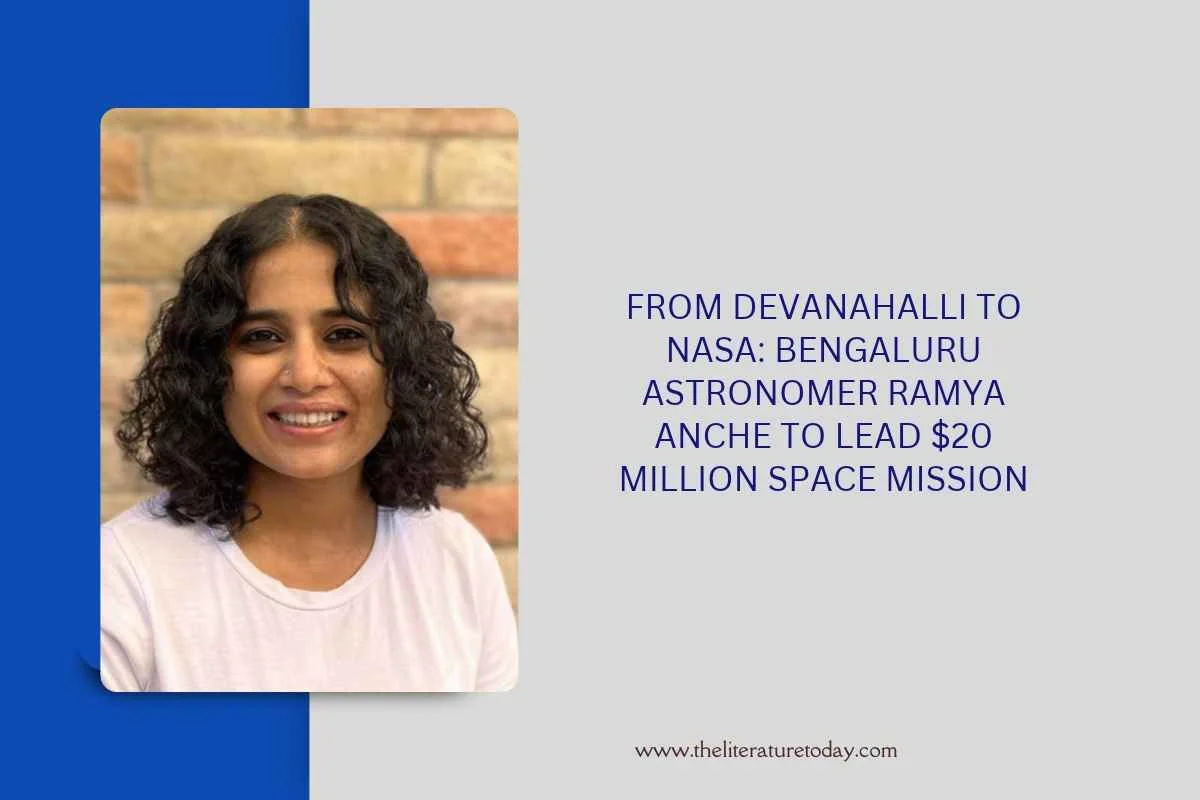
Bengaluru-born scientist Ramya Manjunath Anche is leading NASA’s PUFFINS mission, which aims to study tiny interstellar dust particles using an advanced space telescope expected to launch in 2030.
A young girl from Devanahalli, Bengaluru, once fascinated by questions about space and scientific discoveries, is now leading an ambitious NASA-backed mission that could help scientists better understand the universe. Astronomer Ramya Manjunath Anche has secured $20 million in funding from NASA to develop a specialised telescope designed to investigate some of the smallest particles found between stars.
The mission, known as Polarimetry in the Ultraviolet to Find Features in INterStellar dust (PUFFINS), will focus on studying microscopic interstellar dust grains that are difficult for conventional telescopes to detect. The project is expected to launch in 2030 and will mark an important step in the study of cosmic dust and its influence on the formation of stars and planets.
Ramya, currently an Assistant Research Professor at the University of Arizona's Steward Observatory, is serving as the mission's Principal Investigator.
A Childhood Surrounded by Science and Curiosity
Ramya grew up in a family where scientific discussions were part of everyday life. Her father, A. Manjunath, is a respected microbiologist who retired from the University of Agricultural Sciences in Bengaluru. His work in soil research and his enthusiasm for science played an important role in nurturing her curiosity from an early age.
She completed her schooling at Oxford English School in Devanahalli before pursuing her pre-university education at MES Vidyasagar Prof. MPL Sastry PU College in Bengaluru. Later, she earned a Bachelor of Engineering degree in Electrical and Electronics Engineering from Sir M. Visvesvaraya Institute of Technology.
At a time when Bengaluru's rapidly expanding IT sector attracted many engineering graduates with promising corporate opportunities, Ramya was drawn towards scientific research instead.
She explains that research had always been her primary interest and that her family never pressured her to pursue a conventional corporate career.
Her father also recalls how she developed an interest in science during her school years. Their conversations about scientific subjects encouraged her to question things, explore new ideas and seek answers.
The Columbia Space Shuttle Disaster That Strengthened Her Interest in Space
One significant event that influenced Ramya's interest in science was the tragic Columbia space shuttle disaster on February 1, 2003. The accident claimed the lives of all seven astronauts aboard the spacecraft and left a lasting impact on people across the world.
For Ramya, the tragedy raised important questions about space exploration, scientific challenges and the possibilities of preventing such disasters.
She remembers being deeply affected by the incident and wondering what had caused the tragedy and whether it could have been avoided. That curiosity became one of the motivations behind her decision to pursue science and understand the mysteries beyond Earth.
From Indian Research Institutions to the University of Arizona
Ramya's academic journey continued with an integrated MTech-PhD programme in Astronomical Instrumentation at the Indian Institute of Astrophysics in 2012. She pursued her research under the guidance of Professor G. C. Anupama.
After completing this stage of her academic journey, she undertook a postdoctoral fellowship at the Inter-University Centre for Astronomy and Astrophysics (IUCAA), Pune, during 2020–2021.
In 2021, she moved to the United States and joined the University of Arizona. She currently serves as an Assistant Research Professor at the university's Steward Observatory.
Her research career reached a significant milestone when the proposal she led received NASA's approval and $20 million in funding under the agency's Astrophysics Pioneers programme.
Interestingly, she secured this opportunity while still working as a postdoctoral researcher, demonstrating the scale of the scientific project she had envisioned.
Understanding NASA's $20 Million PUFFINS Mission
The PUFFINS mission is designed to investigate extremely small dust particles that exist in the space between stars. These grains are approximately the size of a common cold virus and remain difficult to study using most existing telescopes.
Although tiny, interstellar dust particles have an important role in the evolution of the universe. They influence how starlight travels through galaxies and contribute to the processes involved in the formation of new stars and planets.
To investigate these particles, PUFFINS will use a specialised technique called ultraviolet spectropolarimetry. The technique will allow scientists to examine the properties of interstellar dust in ways that have not been attempted from space in three decades.
The information collected through the mission is expected to address longstanding gaps in scientific knowledge about interstellar dust and its contribution to the evolution of the universe.
The mission is planned as a five-year project. Its initial phase has already begun, with the team expected to spend the next four years designing and developing the telescope before its scheduled launch in 2030.
For Ramya, the project also represents a major personal achievement. She says this will be the first scientific instrument she has helped design that will actually be constructed and sent into space.
Leading a Team of Around 40 Researchers
As Principal Investigator, Ramya is leading a team of approximately 40 people, including scientists, engineers, graduate students and postdoctoral researchers.
Developing a space telescope of this kind requires collaboration across several scientific and engineering disciplines. Ramya acknowledges the valuable contributions of her colleagues and says she continues to learn from team members who bring considerable experience and expertise to the project.
The mission represents not only an important research opportunity but also a collaborative effort to explore questions about the universe that have remained unanswered for decades.
Must read : NASA invites ISRO to join in planned moon base..
Overcoming Challenges and Breaking Barriers in STEM
Despite growing up in an academically inclined family, Ramya's professional journey was not without challenges. She recalls facing situations where people questioned her ability to pursue physics, mathematics-intensive subjects and engineering projects.
Such experiences were influenced by stereotypes surrounding women's participation and capabilities in science, technology, engineering and mathematics (STEM).
However, she continued to build her career through determination, consistent effort and perseverance.
Today, her leadership of a NASA-funded space mission demonstrates how curiosity, academic dedication and the willingness to pursue unconventional paths can open doors to extraordinary scientific opportunities.
From her early education in Devanahalli to leading an ambitious space research programme in the United States, Ramya Manjunath Anche's journey reflects the possibilities that emerge when scientific curiosity is encouraged and nurtured.
As the PUFFINS team moves towards designing and building its telescope, the mission carries the promise of expanding our understanding of the tiny particles that play a significant role in shaping the universe.








Comments (0)