

Author Spotlight: Sheetal Choksi & Samiran Ghosh – Podcasters, Authors & Tech Storytellers

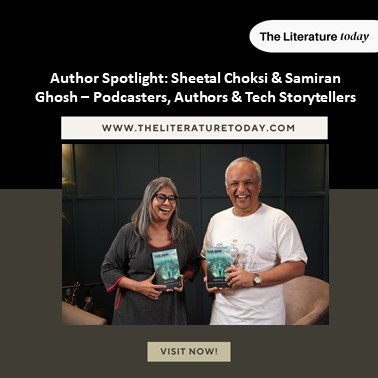
Authors’ Background: Author Sheetal Choksi and author Samiran Ghosh are two-thirds of the award-winning 3 Techies Banter podcast, where sharp insights meet fearless speculation, and irreverence is always welcome. Sheetal is a seasoned qualitative researcher with a knack for uncovering the stories people don’t even realise they’re telling. Whether decoding patterns in human behaviour or spotting meaning in the mundane, Sheetal brings deep curiosity and sharp insight to everything she does! Samiran Ghosh is a technologist, author, and podcast host who delights in connecting obscure historical facts with cutting-edge science and technology. Known for his curiosity and mischievous speculative thinking, he fuels the myth-tech imagination at the heart of the novel.
Questionnaire:
The Literature Today: This novel, “Thuldrun. Sunya,” brings together mythology, quantum physics, and Mumbai’s quirky chaos. What was the catalyst that convinced both of you that this mashup could actually work as a full-blown narrative?
Sheetal / Samiran: The idea was born out of a debate on quantum uncertainty that collided somewhat hilariously with Mumbai’s perpetual chaos and the layered symbolism of Indian mythology. We realised that all three worlds thrive on unpredictability and hidden possibilities. Once we saw that connection, the mashup didn’t just make sense — it became inevitable. If parallel realities exist anywhere, it’s probably in Mumbai.
The Literature Today: You’re both known for your podcast, where you live at the intersection of tech, speculation, and organised mischief. How did that existing creative chemistry shape the writing of your debut novel?
Sheetal / Samiran: 3 Techies Banter taught us to argue fearlessly, think aloud, and build on half-formed ideas without waiting for perfection. We brought that same “organised mischief” into the novel, blending science, mythology, and trivia without worrying about fitting into one genre. Thuldrun.Sunya is essentially our conversational chaos given structure.
The Literature Today: Sheetal, your expertise lies in decoding human behaviour. How did your qualitative research background influence the emotional depth and personality design of characters like Ansh and the supporting cast?
Sheetal / Samiran: Research reminds us that people are shaped by their histories, relationships, and the pressures they carry. We wanted characters who felt real: messy, flawed, curious, and evolving. That’s why Ansh isn’t a typical hero; he’s someone questioning identity and expectation. There’s a moment mid-story where he must decide between fear and action – that scene came directly from studying how people rationalize internal conflict. Our goal was to build characters readers could feel, not just follow.
The Literature Today: Samiran, your love for obscure trivia and historical rabbit holes is legendary. Which unusual fact or half-forgotten theory ended up becoming a cornerstone for the book’s plot?
Sheetal / Samiran: Two threads collided to spark the world of Thuldrun.Sunya:
• Thorium-232, abundant on India’s coasts and safer than uranium, yet historically neglected — what if ancient Indians mastered nuclear energy?
• Sunya, not just zero but a metaphysical void representing infinite potential in Sanskrit texts.
That led to the question: What if ancient scientific knowledge was encoded in language itself?
When thorium met Sanskrit, and science met mythology, Thuldrun was born.
The Literature Today: The novel features an ordinary teenager thrown into extraordinary cosmic puzzles. What made Ansh Chatterjee the ideal protagonist to navigate ancient civilisations and interstellar threats?
Sheetal / Samiran: Ansh is the outsider who never quite fits in; curious, skeptical, and unwilling to accept the obvious. His ordinariness becomes his superpower; he sees what others overlook. He’s the teenager we all once were: asking uncomfortable questions in a world that prefers certainty.
The Literature Today: There’s a rogue hacker, a wild theorist, and even a philosophising dog in the mix. How did you balance humour with high-stakes sci-fi without letting the narrative drift into parody?
Sheetal / Samiran: We let humour emerge organically from character quirks rather than forcing punchlines. Even in tense moments, witty banter offers relief without ever undermining the stakes. The philosophising dog, for example, breaks tension at critical moments in ways that reveal character rather than parody the plot. We wanted fun without foolishness — adventure without absurdity.
The Literature Today: Mumbai plays an almost character-like role in the book. How did the city’s unpredictability — from Bandra Worli Sea Link theories to Mahim’s cosmic energy — shape the world-building of your novel?
Sheetal / Samiran: Mumbai’s backdrop, from the Sea Link’s engineering marvel to Mahim’s metaphysical folklore, creates a sense of grounded magic where the impossible feels oddly plausible. We wanted the city to breathe its own energy into the story, embodying chaos and resilience in equal measure. Mumbai isn’t just a setting; it is the portal where science meets myth.
The Literature Today: Collaboration between two strong creative voices can be both exhilarating and chaotic. What did you learn about each other’s working style while building this multi-layered universe?
Sheetal / Samiran: We discovered how complementary our strengths are. One of us works with structured research and meticulous detail, the other leaps into instinct and imagination. One writes with precision, the other with starlight. And together it works.
The Literature Today: Young readers today expect stories that move fast, think smart, and don’t talk down to them. How consciously did you design the book’s tone to resonate with this newer, sharper audience demographic?
Sheetal / Samiran: We trusted readers to keep up rather than slow down. The book offers clues instead of explanations, expects curiosity instead of spoon-feeding, and embraces irreverence without disrespecting intelligence. Today’s young audience craves speed, depth, and agency — and we wrote for that mindset.
The Literature Today: This story touches on ancient civilisations, lost technologies, and clues leading back 3000 years. What kind of research rabbit holes did you dive into to keep the speculative elements grounded yet electrifying?
Sheetal / Samiran: We dove into Vedic science, quantum theory, thorium energy research, and more obscure sources than we care to admit. The challenge was to anchor speculation in real debates, making every “what if” feel plausible. We wanted facts to serve wonder, not overwhelm it.
The Literature Today: Lastly, with “Thuldrun.Sunya” now out in the world, do you envision this as a standalone experiment or the beginning of a broader myth-tech universe that you plan to expand?
Sheetal / Samiran: The clue is in the title: Book 1 of ∞. It is one of several books (even 1 😀)
This is the first ripple in a larger myth-tech multiverse. Readers are loving the layered universe, and we are excited to expand it through new characters, deeper mysteries, and more philosophical adventures.



Comments (0)