

Exclusive Interview with Rahul Ajit Joshi, Author of Kaalnetra: The Trishul Chapter

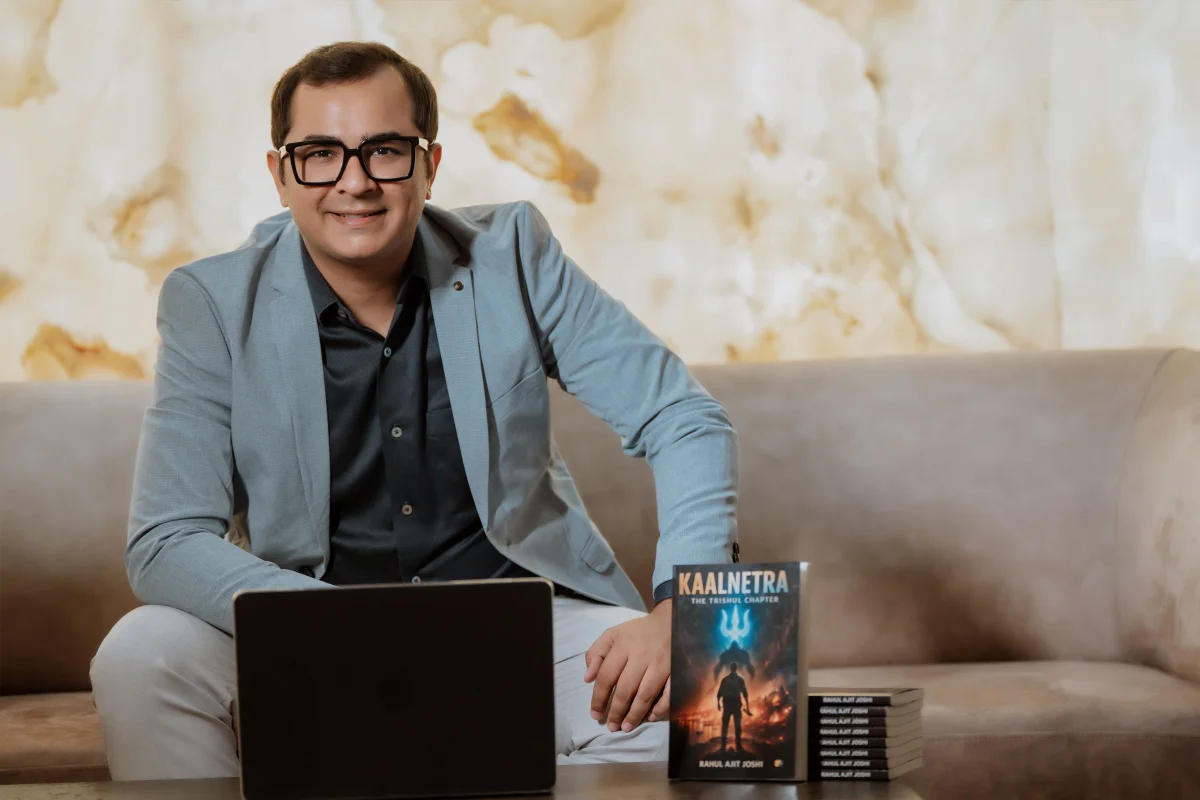
Author Rahul Ajit Joshi is an Indian author and international business entrepreneur known for his high-stakes, fast-paced mythological techno-thrillers. Based in Navi Mumbai, he is the creator of the acclaimed Kaalnetra universe, which weaves together ancient Indian mythology, historical statecraft and speculative futuristic science into immersive, pulse-pounding narratives
Questionnaire:
The Literature Today: You describe mythology as an evolving repository of philosophy and strategy. What inspired you to explore Indian mythology through the lens of a techno-thriller?
Rahul Ajit Joshi: We often treat mythology as ancient history or stories meant only for bedtime reading and religious rituals. But when you look closely at our ancient epics, they are packed with incredible concepts—advanced weaponry, astronomy, energy manipulation, and brilliant military strategy. A techno-thriller felt like the natural format to bring these ideas alive. Modern technology moves at a breakneck speed, while mythology carries timeless truths about human nature and power. By combining high-concept science with ancient philosophy, I wanted to show that our ancestors weren't just writing folklore; they were exploring ideas that feel directly relevant to our high-tech world today.
The Literature Today: Your book, “Kaalnetra: The Trishul Chapter” connects the Mauryan Empire with the modern world. What drew you to Emperor Ashoka as the historical starting point for this story?
Rahul Ajit Joshi: Ashoka is one of the most fascinating figures in world history. We usually hear a simple version of his life: he fought the bloody war of Kalinga, felt deep remorse, and immediately gave up violence for Buddhism. But real leadership and human emotions are far more complex than that.
Ashoka was a sharp ruler who understood global politics. He realized that holding absolute, destructive power was a huge danger to humanity. The centuries-old legend of him forming a secret society of nine men to hide dangerous knowledge from the world has always intrigued me. He wasn't just walking away from violence; he was actively locking away secrets that humanity was too reckless to handle. Setting the beginning of the Kaalnetra story in the Mauryan era allowed me to ground the plot in real, hard-hitting Indian history.
The Literature Today: Interestingly, The Trishul is described as a “witness” rather than a weapon. What does this unusual idea reveal about the artefact and its significance in the story?
Rahul Ajit Joshi: In most action thrillers, an ancient artefact is basically treated like a super-weapon or a secret key that blows things up. But the Trishul carries a much deeper philosophical meaning in Indian culture—representing time, creation, preservation, and balance. Calling the Trishul a “witness” completely changes how power works in this story. It doesn’t just blast through enemies; it observes. It acts as an objective recorder of human choices, mistakes, and history. In the book, the artifact is intimidating not just because of its physical energy, but because it holds an honest mirror up to humanity’s true nature. A conventional weapon attacks the body, but an artefact that judges your soul is far more unsettling.
The Literature Today: How did you balance meticulous historical research with futuristic science and speculative elements while building the Kaalnetra Universe?
Rahul Ajit Joshi: My rule was simple: do justice to both sides. If the history feels made up, readers lose trust; if the science is sloppy, the thriller loses its edge. On the historical side, I studied Mauryan edicts, ancient Sanskrit texts, and temple architecture. On the scientific side, I focused on quantum physics, neurology, and resonance theories. The fun part was seeing where they overlap. For example, when ancient texts talk about unseen cosmic energies, and modern physicists discuss quantum fields, they are often describing similar phenomena using different vocabularies. By anchoring sci-fi concepts in real research and actual historical places, the story feels believable and grounded.
The Literature Today: Well, Priya Malhotra and Arjun Singh come from different fields but are drawn into the same mystery. What makes them compelling protagonists for this journey?
Rahul Ajit Joshi: What makes Priya and Arjun work isn’t harmony—it’s an underlying, unresolved friction. They come from entirely different disciplines, but they are forced together by a sequence of events neither of them can fully control.
The Literature Today: Arjun experiences memories from another life involving forgotten wars and impossible technologies. What fascinated you about exploring the connection between memory, identity and destiny?
Rahul Ajit Joshi: We are who we are because of what we remember. But what happens if the memories in your head belong to a completely different era? Modern science sees memory as brain activity, while Indian philosophy links memory and experience across lifetimes. I wanted to put Arjun right in the middle of that conflict. He isn’t just having strange dreams; he is carrying the weight, trauma, and battle instincts of another existence. It makes him question his own free will: is he making his own life choices today, or is he simply playing out an ancient script? Watching an ordinary man fight to keep his sanity while handling a massive destiny makes for a powerful personal arc.
The Literature Today: The novel suggests that ancient knowledge may have included science capable of influencing thoughts and societies. How did you develop this speculative concept?
Rahul Ajit Joshi: Today, we see algorithms, social media, and digital narratives quietly steering how millions of people think. If you study ancient Indian statecraft, like Chanakya's Arthashastra, you find that power was rarely just about brute military strength—it was about shaping perception, influence, and morale. I took that historical insight and pushed it into speculative neuroscience. What if ancient rituals, sacred sound frequencies, and symbols were early forms of psychological technology designed to guide human behavior? When you look at how quickly societies can shift into panic or change directions, it made sense to explore the idea that the greatest battles aren't fought on open fields, but directly inside the human mind.
The Literature Today: Sacred sites across India become part of an ancient hidden network in the novel. How important was India’s cultural and geographical landscape to the world-building of Kaalnetra?
Rahul Ajit Joshi: India's landscape isn't just window dressing in this story; it plays a crucial role in the plot. Anyone who visits ancient Indian temples, like Ellora or the steps of Varanasi, notices how carefully designed they are. The alignments, acoustics, and stone structures were built with incredible engineering precision. In the Kaalnetra world, these sites are connected parts of an ancient grid. Setting the story in real, famous locations makes the thriller hit closer to home. It turns familiar heritage sites into active puzzle pieces, making readers wonder if the ancient monuments they visit might be hiding something extraordinary.
The Literature Today: Your storytelling combines ancient statecraft with modern scientific principles. How does your understanding of strategy and power influence the conflicts in the novel?
Rahul Ajit Joshi: In global business, you quickly learn that real influence isn't about making noise; it's about control, leverage, and being several steps ahead of everyone else. Ancient Indian statecraft was built on that exact mindset. Leaders used strategies like Sama, Dama, Danda, and Bheda—negotiation, incentive, pressure, and division—to resolve conflicts. In Kaalnetra, the battles aren't simple good-versus-evil fights. Every group, whether an intelligence agency or a shadowy private network, has clear motives and calculated moves. The conflict feels like a high-stakes chess match where every move has a long-term consequence.
The Literature Today: The novel raises the possibility that the truth itself could become a catastrophe. What questions about scientific progress, power and responsibility did you want readers to consider?
Rahul Ajit Joshi: We usually assume that all information should be freely shared, and that more knowledge is always a good thing. But history proves that human ethics often trail behind our technological discoveries. The creation of nuclear weapons and the rise of invasive surveillance are clear reminders of this. In Kaalnetra, I wanted to ask a tough question: What if some secrets are so dangerous that exposing them would tear society apart? Is hiding the truth sometimes necessary to protect people? I want readers to walk away thinking about the responsibility that comes with knowledge, and whether humanity is truly ready for every answer it hunts down.
The Literature Today: As the creator of the Kaalnetra Universe, what can readers expect from the larger journey ahead, and how does The Trishul Chapter establish the foundation for what is yet to come?
Rahul Ajit Joshi: The Trishul Chapter is just the starting point of a much bigger story. This first book sets up the rules of the world, introduces the history, and puts Priya and Arjun on their path. But the upcoming installments will widen the scale significantly. The stakes will grow bigger, hidden factions will step out into the open, and the connection between ancient lore and futuristic technology will become even more intense. This book opens the vault, and the next chapters will push the characters and readers into an unpredictable, high-octane adventure.







Comments (0)