

When Psychology Found Its Way Into Stories — The Inspiring Journey Of Dr. Amandeep Kau
 Mariyam Yasser
Author
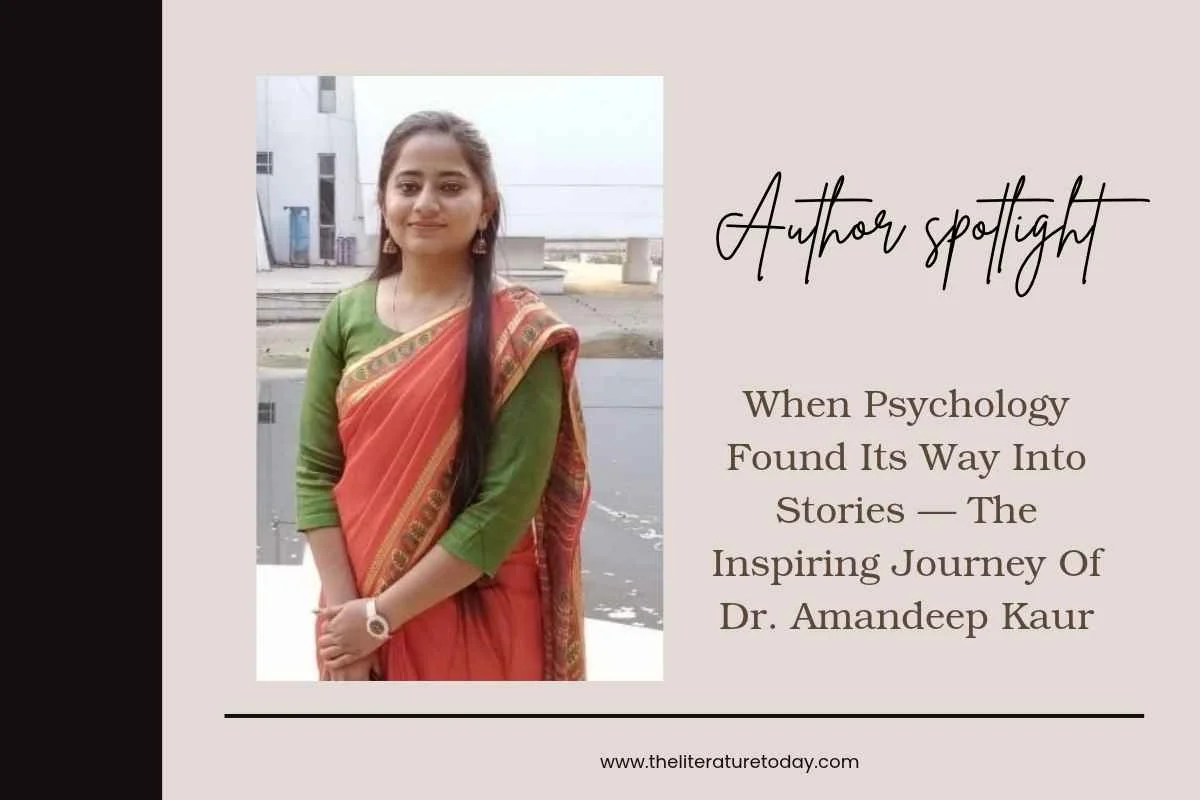
Interestingly, Dr. Amandeep Kaur is a psychologist who chose to tell stories. At the heart of her professional journey lies a deep curiosity about human beings, their thoughts, emotions, relationships, choices and perhaps most importantly, the things they struggle to say aloud. As a counselling psychologist, researcher and academician, Dr. Kaur has spent years engaging with human behaviour through classrooms, research projects, academic inquiry and personal conversations. Yet over time, she discovered that psychology did not have to communicate only through theories, counselling rooms or research papers. It could also reach people through something far more intimate and universally accessible such as in the form of a story. This realisation eventually led to her debut book, “The Heart Has Fifteen Rooms” a collection of fifteen fictional stories that explores love, grief, regret, hope, longing, vulnerability and the quiet emotional experiences that can alter the course of a person’s life.
Dr. Kaur’s journey towards becoming an author has been firmly grounded in a strong academic foundation. With a Ph.D. in Psychology and UGC-NET qualification, she has established herself as a committed academic and researcher with a sustained interest in understanding the complexities of human behaviour. Her dedication to academics was evident from the early stages of her higher education. During her Master’s in Psychology, she secured the top position across all four semesters, an achievement that reflected not only her academic ability but also her consistency, discipline and intellectual engagement with the subject. She was subsequently awarded the College Colour for Academic Excellence, further recognising her outstanding academic performance. These achievements became an important foundation for a career in which psychological knowledge would eventually extend beyond academic spaces and become a means of understanding the lived realities of people.
Her professional journey has been equally shaped by research and direct engagement with human experiences. Between 2019 and 2021, Dr. Kaur worked as a Research Assistant on the major ICSSR research project titled, “Enhancing Reproductive Health of Rural Women through Awareness Programme.” The experience offered her an opportunity to encounter psychology beyond the boundaries of textbooks and theoretical frameworks. Working in the field brought her closer to the realities of women whose health, emotional wellbeing and access to information were deeply influenced by their social circumstances. Such experiences can transform the way a researcher understands human behaviour because they reveal the complex relationship between individual emotions and the larger environments in which people live. For Dr. Kaur, research became not simply a process of gathering information but a way of listening to lives shaped by circumstances, relationships, awareness and social realities.
Her research interests have subsequently extended across areas including reproductive health awareness, psychological wellbeing, mental health and transgender health. Through her academic work, she has contributed to research papers examining reproductive health, psychological wellbeing and health behaviour among transgender individuals, with her work being published in academic journals. Her commitment to research also received recognition in April 2024, when she earned the Best Paper Presentation Award for her work titled, “Psychological Wellbeing and Connectedness among Transgenders: A Mixed Method Approach.” The paper was presented at a Two-Day National Conference organised by the Department of Sociology at Rajiv Gandhi National University of Law, Punjab. This achievement represents another significant dimension of Dr. Kaur’s professional identity, her ability to approach psychological questions with academic rigour while remaining attentive to the social and emotional realities behind the research.
Yet, some of the most meaningful lessons in Dr. Kaur’s journey did not emerge from research papers or academic conferences. They emerged in classrooms and in the conversations that continued after the formal teaching hours had ended. While teaching university students, she noticed that conversations frequently moved beyond academic subjects and towards matters of the heart. Students spoke about love, attachment, heartbreak, confusion and relationships. They had questions about emotions that they genuinely wanted to ask, yet many felt more comfortable discussing such matters informally than entering a formal counselling space. These interactions helped Dr. Kaur recognise an important gap between people’s need for emotional understanding and their willingness to seek conventional psychological support.
This observation eventually gave rise to Coffee with Counsellor, an initiative built around making conversations about emotions and relationships feel more approachable. The concept was simple yet meaningful, involving creation of a space where people could talk about what they were experiencing over something as ordinary and comforting as a cup of coffee. By reducing some of the formality associated with counselling, the initiative sought to make psychological conversations more accessible and less intimidating. For Dr. Kaur, it was another expression of her belief that psychological understanding does not always need to arrive in a formal or clinical setting. Sometimes, it begins with a conversation in which someone feels comfortable enough to say what they have been carrying silently.
Coffee with Counsellor also became an important turning point in her evolution as a storyteller. Through these conversations, Dr. Kaur realised that psychology does not always have to reach people through direct advice. Sometimes, a story can accomplish something that advice cannot. A story allows readers to observe another person’s choices, contradictions, losses and moments of realisation without feeling that they themselves are being instructed. It creates distance while simultaneously creating recognition. This insight became one of the foundations of “The Heart Has Fifteen Rooms” allowing Dr. Kaur to bring together her psychological understanding and her literary imagination without allowing one to overwhelm the other.
Also read : Beyond Motivation, Dr. Manjula pooja shroof explores DHI ALCHEMY...
Well, “The Heart Has Fifteen Rooms” is a collection of fifteen fictional stories that journeys through some of the most universal and emotionally complicated aspects of human existence. Love and loss occupy an important place within the book, but the stories reach far beyond romantic relationships. They explore attachment, absence, regret, shame, longing, memory, choices, vulnerability and the consequences of things people sometimes understand only after they have lost them. The characters inhabit different emotional spaces, yet each story is connected by the larger question of what happens within us when relationships, circumstances or choices force us to confront parts of ourselves that we might otherwise prefer to avoid.
Moreover, the response to Dr. Kaur’s debut has added another encouraging chapter to this journey. Readers have deeply appreciated “The Heart Has Fifteen Rooms” on Amazon, where it has received great reviews and high ratings. Such appreciation is particularly meaningful for a book that asks readers to engage with emotionally intimate subjects. When readers recognise themselves, their memories or their relationships in fiction, the distance between author and audience begins to disappear. The positive response suggests that the stories have found resonance with readers who value emotionally rich contemporary fiction while also appreciating meaningful psychological insight.
Must read : Her heart their journey book spotlight - Kishori Mahadhik
With, “The Heart Has Fifteen Rooms” Dr. Kaur has opened fifteen fictional doors into the emotional world of human beings. Behind those doors are stories of love and loss, grief and hope, regret and longing, vulnerability and self-discovery. Yet the most important invitation the book extends is perhaps the simplest one that is to look at ourselves and others with a little more kindness. By allowing psychology to quietly inform fiction rather than dominate it, Dr. Amandeep Kaur has created a literary space where readers can experience stories first and reflect upon them afterwards. Her debut marks the beginning of a promising chapter in her evolution from psychologist to storyteller, while remaining deeply rooted in the years of research, counselling, teaching and human connection that came before it. In her world, psychology does not end when the counselling conversation is over; sometimes, it continues in a story, in a character, in a memory and perhaps, in one of the fifteen rooms of the heart.






Comments (0)