

An Exclusive Interview- Dr. Sujay Kantawala Author of the Book The Verdict: Who Killed Sonia Verma?

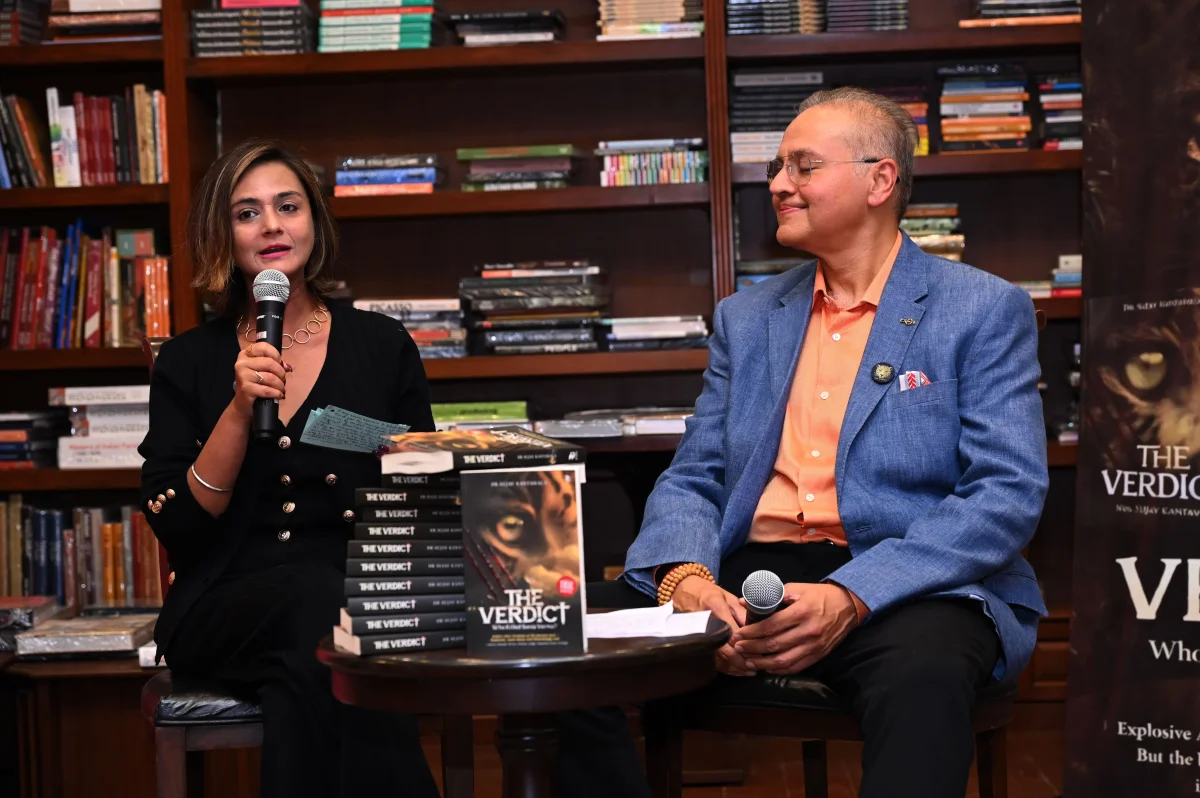
Dr. Sujay Kantawala is a distinguished advocate, legal commentator, and a versatile author based in Mumbai, India. With a career at the Bar spanning over three decades since 1991, he has established himself as a prominent figure in the Indian legal landscape, frequently appearing before the Supreme Court and various High Courts across the country.
Beyond his legal practice, Dr. Kantawala is a prolific writer who seamlessly bridges the gap between the structured world of law and the creative realms of fiction and poetry. His literary repertoire includes the high-stakes legal thriller Curse of Suspicion (2020), the psychological murder mystery Windswept: The Perfect Murder (2021), and his latest 2026 release: The Verdict. He is also the author of a celebrated series of poetry coffee-table books, including Thoughts and Thoughts... flow on.
A familiar face on national television, Dr. Kantawala has participated in over 1,000 live debates, offering expert legal analysis on pressing socio-legal issues. When not in the courtroom or at his writing desk, he is a dedicated environmentalist and philanthropist, having planted over 1,500 trees at his Boisar farmhouse and actively supporting local primary education initiatives. Follow Dr. Sujay Kantawala on Amazon to stay updated on his latest releases in legal thrillers.
TLT: With more than three decades in the legal profession and appearances before the Supreme Court of India and several High Courts, which experiences have played the most significant role in shaping your professional philosophy?
Dr. Sujay: The pursuit of institutional integrity and the rights of citizens has shaped my professional philosophy. Over more than three decades of practice before the Supreme Court of India and various High Courts, the experiences that have stayed with me are not necessarily the high-profile courtroom victories, but the quieter battles fought by ordinary people against powerful institutions. Those cases taught me that the law cannot remain an abstract set of rules. It has to protect human dignity. I have seen how evidence can be manipulated and how vulnerable an individual can become when confronted by institutional power. These experiences reinforced my belief that an advocate’s duty requires persistence, courage and integrity. Justice must never look away when power enters the room.
TLT: Your practice has involved constitutional law, criminal litigation and public interest matters. Which area of legal practice has challenged you the most intellectually, and why?
Dr. Sujay: Public Interest Litigation, particularly where it intersects with constitutional law, has challenged me the most. Constitutional law requires a broad understanding of principles, while criminal litigation often demands tactical precision. Public interest matters require both, but with an additional responsibility: the outcome can affect people far beyond the individual litigant. A PIL may involve large amounts of administrative, financial or environmental information, often accompanied by competing versions of events. The challenge is to understand all of it, identify what is legally significant and turn it into an argument that can lead to a practical solution. For me, that process of connecting constitutional principles with the realities of people’s lives is what makes this area so intellectually demanding.
TLT: Having participated in more than 1,000 live television appearances, how has engaging with the media changed the way you analyse and communicate complex legal issues?
Dr. Sujay: Live television has taught me brevity, mental agility and, above all, clarity. In court, an advocate has detailed briefs, written submissions, authorities and time to develop an argument. On television, you may have sixty seconds to explain a complicated judgment or constitutional issue to someone with no legal training. That experience changed the way I communicate. It taught me to remove unnecessary legal terminology and identify the human and institutional questions at the heart of an issue. I have always believed that the law should be accessible to citizens. If a legal expert cannot explain a complicated issue simply, the answer is not to blame the audience for failing to understand it.
TLT: Your professional career and your literary career operate in very different spaces. What prompted you to begin writing fiction, and how did your first book come into being?
Dr. Sujay: The courtroom is an extraordinary repository of human stories, but only a part of those stories can enter the formal record. Over the years, I encountered moral ambiguities, hidden motivations, psychological conflicts and emotional consequences that could never find space in a legal brief. Fiction gave me the freedom to explore those other dimensions of human behaviour. My early novels, ‘Love Knows No Boundaries’, ‘Windswept’ and ‘Curse of Suspicion’, grew from my interest in how ordinary human weaknesses such as paranoia and jealousy can affect relationships and eventually draw people into the criminal justice system. With ‘The Verdict: Who Killed Sonia Verma?’, I moved further into the legal thriller genre of writing and deliberately introduced the retired judge Karan Negi as the central character. Writing fiction therefore did not feel like a departure from my professional life. In many ways, it was another way of examining the human condition, law, truth and justice.
TLT: Your novels are rooted in the world of law, yet they remain accessible to readers beyond the legal profession. When developing a story, what do you consider more important: legal precision, character development or the momentum of the narrative?
Dr. Sujay: For me, character and narrative come first, while legal accuracy provides the foundation. A legal thriller should never read like a textbook. The reader should remain immersed in the story rather than feel that they are attending a law lecture. The legal framework has to be authentic, but it should serve the story rather than overwhelm it. A reader stays awake until two in the morning because they care about a character or need to know what happens next. My objective is therefore to make the law credible without allowing technical detail to interrupt the emotional momentum of the narrative.
TLT: ‘The Verdict: Who Killed Sonia Verma?’ is set in Pelling, Sikkim. What significance does the location hold within the novel, and how did the setting influence the atmosphere of the story?
Dr. Sujay: Pelling is not simply a backdrop in ‘The Verdict’; in many ways, it becomes another character in the novel. Its mist-covered hills, cold weather and geographical isolation contribute directly to the atmosphere of the story. I wanted the landscape to echo one of its central ideas: that truth can remain hidden beneath layers of uncertainty. There is also a striking contrast between the serenity and beauty of Sikkim and the darker human conflicts unfolding within the story. The isolation creates a certain psychological pressure and forces the characters to confront questions of responsibility that they might otherwise avoid. The landscape therefore does more than establish a sense of place; it becomes part of the tension of the story.
TLT: Your writing has been described as restrained rather than sensational. Was this a deliberate creative choice, and what kind of reading experience do you hope this approach creates for your audience?
Dr. Sujay: Yes, it is deliberate. I have always felt that the most serious compromises in real life rarely happen with dramatic theatrics. They often happen quietly; through a conversation, a missing document, a convenient omission or institutional indifference. I therefore prefer suspense that grows from circumstances and character rather than from sensationalism. A restrained approach allows the reader to become increasingly aware of what is happening instead of simply being shocked by it. I want readers to feel the weight of the choices being made and to recognise the quiet courage, as well as the quiet compromises, that can shape human behaviour.
TLT: Legal cases often involve conflicting versions of truth. When constructing characters and their motivations, how do you approach the distinction between what is legally provable and what may be morally true?
Dr. Sujay: That tension lies at the heart of much of my fiction. A court can decide only on the basis of the evidence placed before it and the law applicable to that evidence. Moral truth can be much more complicated. Someone may be morally responsible for an act but escape conviction because the evidence is inadequate. Conversely, a person may find themselves under suspicion because circumstances point towards them, even though the complete truth is more complicated. As a writer, I position my characters within that painful crack between legal proof and moral truth. What happens to a person’s conscience when the official outcome does not correspond with what they believe to be right? That conflict can create much deeper psychological drama than a straightforward battle between good and evil.
TLT: ‘Curse of Suspicion and Windswept: The Perfect Murder’ established important chapters in your literary journey. What did writing these earlier works teach you that later influenced your approach to ‘The Verdict’?
Dr. Sujay: My earlier novels taught me the importance of balancing the plot with psychology. ‘Curse of Suspicion’ helped me understand how to manage multiple characters and layers of legal intrigue without losing the central narrative. ‘Windswept: The Perfect Murder’ allowed me to explore atmosphere and psychological suspense more deeply. By the time I began writing ‘The Verdict’, I had become more comfortable trusting the reader. I learned that everything does not have to be explained immediately. Sometimes a pause, an unanswered question or a carefully placed detail can create more suspense than a page of exposition. That led me towards the slower, more atmospheric style of The Verdict.
TLT: Alongside your fiction, you have written the poetry trilogy ‘Thoughts, More Thoughts, and Thoughts Flow On’. What inspires you to move between poetry and narrative fiction, and how do these two forms speak differently to you?
Dr. Sujay: Moving between fiction and poetry gives me a necessary balance. A legal career and a tightly plotted thriller both demand logic, structure and precision. Every fact must fit, every timeline must hold, and every piece of evidence must make sense. Poetry is different. It is the pause. It is where I go to breathe freely. It allows me to capture an emotion or observation without having to construct an entire narrative around it. My poetry explores relationships, nature, solitude and moments of introspection. If fiction is a house that I build brick by brick, poetry is simply looking out of the window at the rain. All the poetry in all my books are written by me to weave into the fabric of the story.
TLT: ‘The Verdict’ achieved notable visibility following its launch at the New Delhi World Book Fair and subsequently achieved Amazon India’s bestseller spot. How do you personally measure the success of a book beyond rankings and commercial recognition?
Dr. Sujay: Rankings and commercial recognition are certainly gratifying, but they are not how I ultimately measure a book’s success. For me, the more meaningful measure is the conversation a book creates when the book achieved No.1 spot on Amazon India, it was comparable to reaching the summit of Mt.Everest. If a young, first-generation lawyer tells me that a character or situation reflects an ethical dilemma they have encountered in their own professional life, that matters. If a reader with no legal background tells me that the book made them look at crime, evidence or justice differently, that matters even more. A book succeeds when it continues to live in the reader’s mind after the last page. If it encourages someone to question, reflect or look at an issue from another perspective, I consider that a meaningful achievement.
TLT: After decades of professional engagement with law, public issues and human conflicts, what aspect of human behaviour continues to intrigue you most as a writer?
Dr. Sujay: I remain fascinated by the contrast between human greed and the resilience of conscience. What interests me particularly is how otherwise decent individuals can rationalise questionable choices when placed under pressure; whether that pressure comes from money, ambition, fear or power. But the opposite is equally fascinating. An ordinary person can reach a point where they decide that they will no longer compromise their principles, regardless of the consequences. That space between human weakness and moral courage continues to interest me. Perhaps that is because it is where many of our most important choices are made.
TLT: Looking ahead, what new ideas, literary projects or professional pursuits are you most eager to explore, and is there a particular direction in which you would like your writing to evolve?
Dr. Sujay: My next book, ‘The Scorpion: No Trace…No Case’, pushes the psychological and legal dimensions further. I would like my writing to move further beyond the conventional murder mystery and explore legal thrillers as stories inspired by reality about society, institutions and human behaviour. Ultimately, I want the books to entertain the reader, but also leave them with an insightful question they ponder about.


Comments (0)